ESD Products.biz

C.C.Steven and Associates, 1363 Donlon Street, Ventura, CA  93003 since 1978  

ph:  805-658-0207          fax:  805-658-2789            static@ccsteven.com


  • Safe, secure ONLINE ORDERING now available
  •  

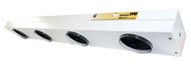
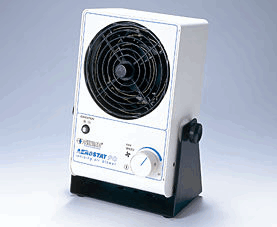
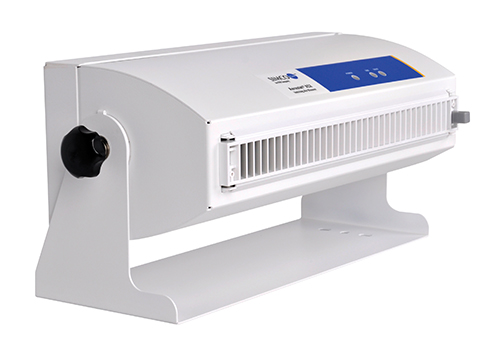
  • ESD Protection While Maximizing Bench Space
  •  

  • Offering Your Quickest Decay Times
  •  

  • For Use With or Without Airflow in Bench and Room Applications
  •  

  • To Clean While Neutralizing
  •  

  • For Unattended Cleaning
  •  

  • Power multiple pin applications
  •  

  • Latest Technology in Clean Room Ionization

  • Some Observations About Ionization

    Electrostatic Discharge (ESD) can be defined as the transfer of an electrostatic charge between objects at different potentials. Eliminating any difference in potentials between the items susceptible to damage at small  voltages and its surroundings will prevent ESD from occurring.  Fulfilling  this concept is the underlying goal in the establishment of an ESD control program.

    There are three events which can occur to an object that can result in electrical charge. They are covered below:

    A) The transfer of electrons from one body to another in direct contact  resulting in a net positive or negative charge.

    The movement or transfer of  electrons is due to the interaction of two bodies. Some substances readily give up electrons while others tend to accumulate electrons. When two substances are  contacted and separated from one another, one substance gains electrons and  becomes negatively charged; the other loses electrons and becomes positively charged. Such contact and separation is called triboelectrification.

    Charges  on a conductor are distributed over its entire surface and the surfaces of other  conductive objects which it contacts due to a free flow of electrons. Charges on  non conductors tend to remain in the localized area of contact since there is no  free flow of electrons.

    Conductors can be grounded, insulators must be neutralized with ionization.

    B) In electrical conductors, electrons can move or migrate within a body resulting in polarization; this can occur even when a single body has no net charge.

    Around each charged body is an electrostatic field. Conductive and dissipative bodies that enter that field will be polarized. In a conductive or  dissipative body, electrons closest to the field will realign dependent on the polarity of the field, leaving negatively and positively charged areas. The net  charge on the body will remain zero.

    If a conductive polarized body is  momentarily grounded however, electrons will flow to or from the polarized  surface near the ground; the body itself becomes charged by accumulation or depletion of electrons. This process is called induction.

    Induction charging is the greatest threat to an ESD control program, and can only be handled by eliminating insulators from the workplace, or using ionizers to neutralize them.

    C) In insulated electrical conductors, electron flow can occur between a body surrounded by ions. Flow will either occur toward or from ions -- dependent upon polarity.

    Should surrounding ions be imbalanced, the net charge on the insulated conductor will also be imbalanced due to this flow. Air ionizers, commonly employed to counter the detrimental effects of ESD on parts, can be a source of imbalanced ions. Charged plate analyzers used to test the balance of ionizers employ this very principle. Imbalanced air ions will leave a net charge on an isolated conductive plate. The voltage measured on the plate will reflect  the net charge left due to the imbalanced situation.

    Here again, the equation Q = C V comes into play ( refer to INSTRUMENTATION page). The imbalance of the  ionizer is Q (charge). V (voltage) is then inversely proportional to C  (capacitance). Should the charged plate analyzer read 50V imbalance for 20pf,  you can expect a 2pf device to read 500V.

    Employ only balanced ionizers to this end.

    Back to Top

    Controlling Static Charges

    Why Static Charges Are a Problem

    Control of static charges in cleanroom manufacturing processes is critical because it can have a significant impact on productivity and device yields. Serious problems often result from:
    *  Device degradation  or failure due to Electrostatic Discharge (ESD)
    *  Particle contamination  caused by Electrostatic Attraction (ESA)
    *  Process equipment malfunction resulting from ESD events

    Many of the processes used to manufacture products in the semiconductor, flat  panel display, disk drive and medical device manufacturing industries require  use of non-conductive materials and isolated conductors. These materials  generate and retain large charge potentials. In addition, process equipment and  materials facilitate charge introduction on the wafers, glass substrates, magnetic media, and magnetic heads produced by these industries.

    Wafers and FPDs which become charged through handling and transporting act as  a magnet for airborne contaminants, which can significantly affect yields in critical processes such as photolithography, coating, and etching. A dependable  ionization system is needed to keep static charges at a low level so  contaminants are not attracted to sensitive surfaces during these critical assembly and manufacturing processes.

    Grounding, using items such as wrist straps and conductive foot wear, is the first line of defense in controlling static charge and will dissipate static  very rapidly. But in many cases grounding is impractical or impossible. Ionized  air can bridge the gap between charged objects and ground potential. “Conductive  air” allows electron flow to or from any charged object, satisfying any charge imbalance.

    Air Ionization


    Air  ionization complements and completes any program that intends to eliminate all  electrostatic charge sources. In many areas, such as cleanrooms and mini  environments, air ionization is the only practical method of static control. A  typical room ionization system can remove 1,000 volts in less than 1 minute.  Research has shown that room ionization typically reduces particle counts by 50% to 90%. Room ionization can increase equipment uptime and decrease tool repair  costs up to 50%.

    Ionizers give molecules in the air the ability to carry charge. These charged  air molecules are able to neutralize electrostatic charge on both insulators and conductors. An air ionizer is capable of neutralizing charge because it produces mobile positive and negative charge carriers. Two mechanisms allow these ions to  neutralize charge; conduction and exchange. Neutralization of charge by air ions  is dependent on a number of complex interactions. Ions move by electrostatic force and are often assisted by airflow to the target object or surface.

    Air ionizers are capable of delivering many benefits including: control of particle contamination, protection of electrostatic discharge sensitive devices,  and reduction of process equipment lock-up. The requirements for ionizer discharge time and ion balance performance should be determined as a consideration of your process or product

    .

    Back to Top

    AC or DC?


    AC ionizers produce positive and negative ions by  applying a high-voltage AC waveform at the supply frequency.

    One emitter may be used to produce ions; both positive and negative ions are produced at each emitter. This is a unique feature and the defining  characteristic of AC technology. The AC advantage is in part the result of the  ability to produce bipolar ions from a single emitter. AC systems can be located  closer to objects than DC systems since each emitter is bipolar and the time and distance between ion polarities is short.

    Stability is enhanced since each emitter is uniformly subjected to the differing wear patterns characteristic of positive and negative emitter electrodes. The fast cycling of AC frequency reduces the build-up of emitter  contaminants that attack electrode surfaces. Stable balance performance is  offered by AC technology.

    The fast AC cycle times produce a nearly continuous stream of bipolar ions.  The short time separation helps to assure rapid and complete neutralization of charges. In AC systems, loss of an individual emitter typically has very little  impact on overall system performance and will not result in a state of system ion imbalance.

    Steady State DC (SSDC) ionizers generate bipolar ions using independent  positive and negative power supplies connected to dedicated emitters. SSDC systems require a minimum of two emitters to generate bipolar ions. Both positive and negative power supplies operate continuously, creating ions at each emitter. SSDC ionization creates a very high ion current, since it produces ions of both polarities with no off-time cycle. Properly designed systems and emitter  spacing will result in a minimum of space charging and low offset voltage.  Recombination of the bipolar ions can be reduced by controlling the distance  between the positive and negative emitters.

    ON/OFF switching of DC power supplies can occasionally result in “noise” (RFI  and EMI) that can affect electronic circuits and cause process equipment  lock-up. Steady State DC avoids this consequence. SSDC systems are the preferred alternative in room systems applications that require low offset voltage and  minimum space charge.

    Pulse DC is the newest development in corona ionization operating modes. It  is more complex and more demanding in its operating requirements and setup. As  in Steady State DC, independent positive and negative power supplies are  connected to dedicated emitters to generate bipolar ions.

    In this case a square wave oscillation of the independent power supplies is  used. The pulse rate is slower than AC and performance becomes similar to SSDC  when the frequency approaches 10 Hz. Pulse frequency impacts balance and total  ion output. Longer pulse times are used as the distance from the emitter to the target object increases. Longer pulse duration is also useful as air velocity in the environment decreases.

    The major advantage realized by pulsing positive and negative ions is  optimizing the number of ions available to eliminate electrostatic charge. The technology allows bipolar ion separation in time. Separation reduces the chance  positive and negative ions will recombine before they reach the intended target.  Pulse DC makes it possible to effectively ionize the air in rooms with low air  velocity.

    Back to Top

    Visit our other sites to further enhance your manufacturing operations.  Click on a button below: